
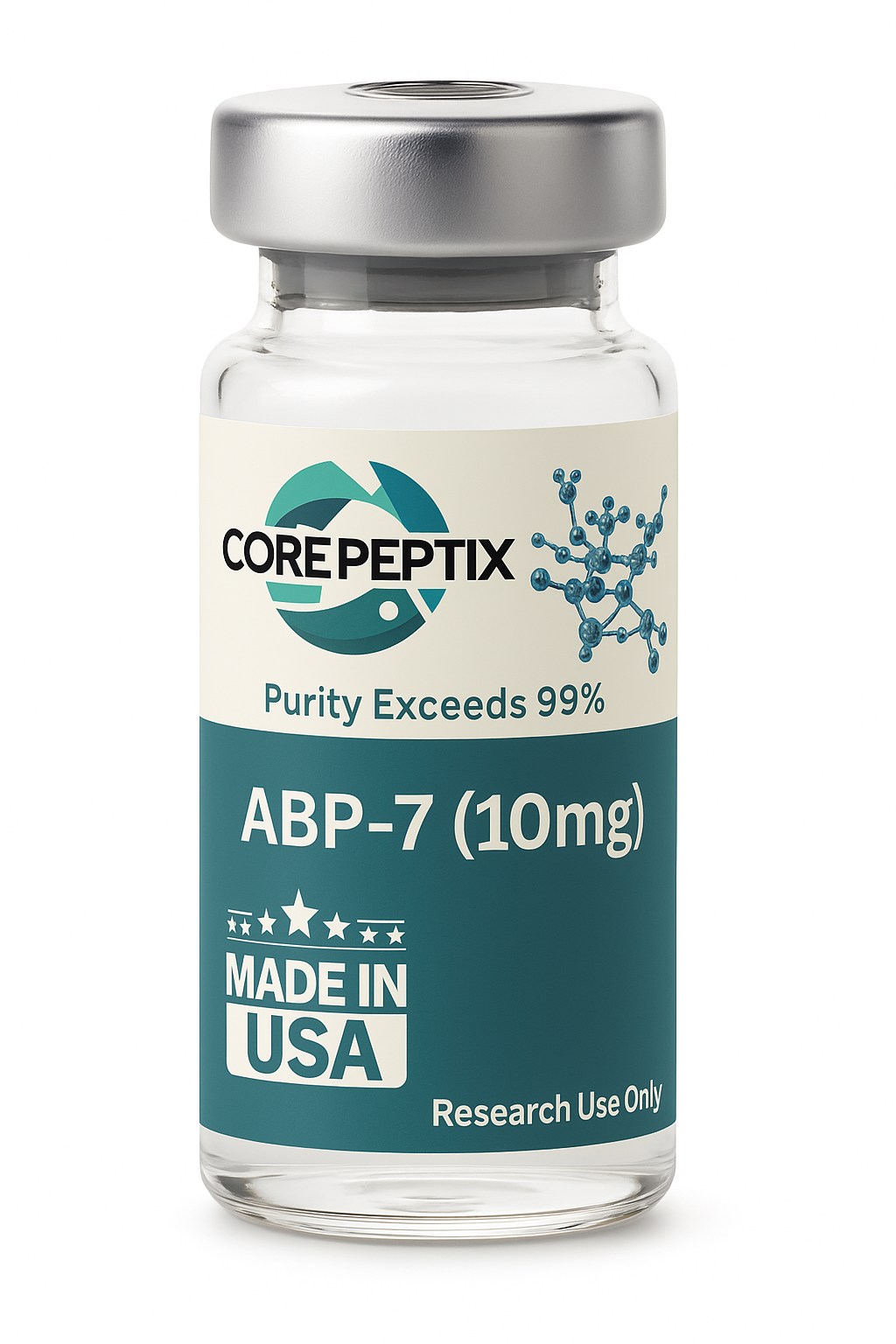


ABP-7 (10mg)
Original price was: $110.00.$92.00Current price is: $92.00.
Size: 10mg
Contents: ABP-7
Form: Lyophilized powder
Purity: >99%
SKU: P-ABP-7
FREE Shipping on $200+ orders
| Quantity | Discount | Price |
|---|---|---|
| 5 – 8 | 5% | $87.40 |
| 9 + | 10% | $82.80 |
Understanding ABP-7 Peptide
ABP-7 Peptide Scientific research has advanced rapidly, revealing innovative compounds that aid recovery and enhance wellness. Among these, one remarkable discovery is a peptide known for its regenerative potential. This compound supports the body’s natural repair process, making it a valuable addition to laboratory-based peptide studies.
Scientists classify it as a synthetic amino acid chain that targets muscle, tendon, and tissue repair mechanisms. Its molecular sequence interacts efficiently with cellular receptors, triggering faster recovery responses. Many laboratories have explored its biological behavior, particularly its influence on tissue regeneration, cellular metabolism, and overall vitality.
Researchers emphasize that this compound is designed for research use only. It is not intended for human or animal consumption. Its consistent purity and precise formulation make it an excellent choice for experimental and laboratory environments.
Application and Use of ABP-7 Peptide
Laboratories investigating cellular recovery mechanisms often utilize this peptide to observe muscle and connective tissue responses. When introduced into controlled environments, it encourages cell signaling related to tissue rebuilding. Through this process, it provides critical data for future biomedical applications.
In research studies, typical dosages range between 200 mcg to 500 mcg per study subject, depending on the desired experimental outcome. The compound is usually reconstituted with bacteriostatic water to maintain stability during use. Laboratories are advised to store it at temperatures between 2°C and 8°C, ensuring maximum peptide integrity.
Transitioning between research stages requires consistent analysis of molecular interactions. Scientists measure recovery markers such as collagen production, muscle fiber regeneration, and inflammation reduction. Each observation contributes to a better understanding of how this peptide supports tissue healing under controlled conditions.
When combined with other recovery-focused peptides, the compound often exhibits synergistic properties. Researchers studying injury repair or muscle stress reduction frequently include it in advanced peptide protocols. Its unique molecular profile provides measurable results that advance peptide science further.
Advantages of ABP-7 Peptide in Research
The potential benefits observed during research are highly promising. Many laboratories report accelerated recovery patterns in cell and tissue cultures. These findings highlight its strong regenerative influence on muscle fibers, tendons, and other connective tissues. Additionally, its structural stability enhances absorption efficiency in experimental settings.
Another significant advantage is its molecular compatibility. It works harmoniously with other regenerative peptides, allowing for broader research possibilities. Because of its high purity, the results from studies using this compound are often reliable and repeatable. This precision ensures that the peptide delivers consistent outcomes when used under standardized laboratory conditions.
Transitioning to its broader implications, researchers believe that studying this peptide may uncover new pathways for tissue regeneration. Continuous exploration of its properties might eventually lead to more effective solutions for cellular recovery and inflammation control. Such advancements could transform future scientific approaches to rehabilitation and performance recovery.
Furthermore, its manufacturing quality ensures optimal stability. Laboratories using pharmaceutical-grade batches can rely on consistent potency throughout their investigations. Proper handling and controlled storage conditions extend its usability, which supports ongoing experiments requiring repeated data collection.
Overall, these characteristics make the compound an exceptional addition to any regenerative or peptide-based study. The steady growth in peptide science continues to reinforce its role as a valuable molecule for laboratory research.
Conclusion on ABP-7 Peptide Research
In conclusion, the ongoing exploration of this peptide represents a promising step toward scientific progress. With strong regenerative potential and reliable purity, it provides an ideal framework for understanding cellular recovery mechanisms. Each experiment contributes valuable insights that may inspire new advancements in peptide-based biotechnology.
Researchers should remember that the compound is strictly intended for research use only. It must not be used for human applications or self-administration. Maintaining ethical laboratory standards ensures that studies remain credible and compliant with scientific regulations.
With proper handling, accurate dosing, and controlled testing environments, the peptide continues to prove its value in regenerative research. Its consistent performance supports countless laboratories aiming to understand tissue healing and cellular repair.
Future developments may expand the compound’s applications across advanced peptide studies. Continued investigation will likely reveal even greater potential in improving recovery and optimizing biological function at a cellular level.
Through responsible research and ethical practices, scientists worldwide can continue uncovering new possibilities in the field of peptide science. The contribution of this compound to regenerative study remains a strong foundation for future discoveries in molecular biology and peptide innovation.
References:
- Esposito, S., Deventer, K., Goeman, J., Van der Eycken, J., & Van Eenoo, P. (2012). Synthesis and characterization of the N-terminal acetylated 17-23 fragment of thymosin beta 4 identified in TB-500, a product suspected to possess doping potential. Drug testing and analysis, 4(9), 733–738. https://doi.org/10.1002/dta.1402
- Sosne, G., Qiu, P., Goldstein, A. L., & Wheater, M. (2010). Biological activities of thymosin beta4 defined by active sites in short peptide sequences. FASEB journal : official publication of the Federation of American Societies for Experimental Biology, 24(7), 2144–2151. https://doi.org/10.1096/fj.09-142307
- Philp, D., Badamchian, M., Scheremeta, B., Nguyen, M., Goldstein, A. L., & Kleinman, H. K. (2003). Thymosin beta 4 and a synthetic peptide containing its actin-binding domain promote dermal wound repair in db/db diabetic mice and in aged mice. Wound repair and regeneration : official publication of the Wound Healing Society [and] the European Tissue Repair Society, 11(1), 19–24. https://doi.org/10.1046/j.1524-475x.2003.11105.x
- Huang, C. M., Wang, C. C., Barnes, S., & Elmets, C. A. (2006). In vivo detection of secreted proteins from wounded skin using capillary ultrafiltration probes and mass spectrometric proteomics. Proteomics, 6(21), 5805–5814. https://doi.org/10.1002/pmic.200600163
- Shah, R., Reyes-Gordillo, K., & Rojkind, M. (2018). Thymosin β4 inhibits PDGF-BB induced activation, proliferation, and migration of human hepatic stellate cells via its actin-binding domain. Expert opinion on biological therapy, 18(sup1), 177–184. https://doi.org/10.1080/14712598.2018.1478961





Reviews
There are no reviews yet.